
Technology
Business
The Aleph Zero Validator Program Will Be Open for Everyone
Jul 12, 2022
AI Summary

As the Aleph Zero team begins to experiment with community validators, we do want to share a rather important piece of information: everyone will be able to validate the network.
We’re happy to confirm what we’ve known for a while: everyone interested in validating the network will have the opportunity to do so from the moment the program is launched. The primary requirements will be to hold the minimum of 25 000 AZERO and fulfill the performance expectations both on the hardware side as well as the network uptime.
Additionally, we will be running a short onboarding session that will assist prospective validators in getting everything up and running. Besides setting up the node, validators will need to fill out a short form (around 10 input fields) and sign a single message.
That’s it.
The Validator Program Will be More Accessible From the Start
Given the popularity of the validator program and seeing over 5000 sign-ups executed via the https://testnet.alephzero.org form, we began to think about simplifying the flow of becoming a validator in the spirit of everybody wins.
Acting in the best interests of decentralization, we were not particularly fond of the initial authority list idea ourselves—which is why we’ve begun to look for ways to obliterate it completely. We’re happy to inform you that our journey ended successfully and that Aleph Zero will be made available to everyone who chooses to help secure and decentralize the network.
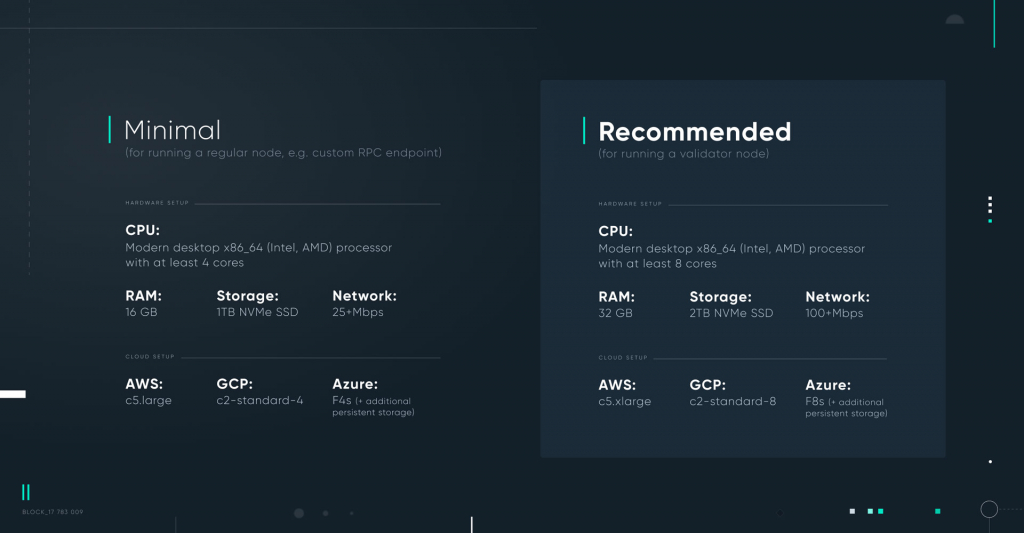
Moreover, we’ve also managed to lower both the recommended and minimal hardware specifications:
Committee Rotation Is Live on Testnet
With the recent launch of smart contracts on the testnet, we’ve also introduced the committee rotation mechanism—which, in short, is the Aleph Zero design for decentralizing the chain. For each epoch, a large validator pool will be determined, with a different committee chosen for every session. A session lasts 900 blocks (15mins) and an era lasts 96 sessions (24h) ensuring frequent rotation of the committee.
How Are Rewards Calculated?
Era rewards
In each era we split rewards accordingly:
- 90% goes to nominators and validators,
- 10% goes to the treasury.
Inflation
We use uniform era payout, meaning that in each era, we reward validators and nominators a constant amount of tokens, which is approx 73 921 tokens, calculated as 0.9 * 30 mln tokens divided by 365.25 – the average number of days in Julian year.
Rewards key takes
- Validators and their nominator’s reward bucket are proportional to the validator’s uptime.
- Rewards assigned to a particular validator, are split among the validator itself and its nominators proportionally to their stake.
At the moment, only the nodes operated by Aleph Zero Foundation are subject to rotations as we are on the cusp of another large update that will introduce the community validators in the upcoming weeks.
Besides the democratic arguments that speak in favor of a more fluid validator selection model, there are also technical arguments that reveal the benefits of rotating committees. In the model pursued by Aleph Zero, a fixed block committee will be chosen every 15 minutes that will validate transactions during this time. This results in a system in which during one era (24 hours), 96 unique committees are selected throughout the day resulting in a more diverse set of actors double-checking the consistency of the chain while also being responsible for appending new blocks.
Inclined to know more? Expand your background on rotating committees and the role they play in securing the Aleph Zero network.
Background on the Aleph Zero protocol, AlephBFT
Aleph Zero employs a Proof-of-Stake (PoS), Directed Acyclic Graph (DAG)-based consensus protocol in which a rotating committee of validators decides on the truthfulness of the state of the transactions. While it might sound similar to other networks employing a PoS methodology, the Aleph Zero implementation of the DAG is a bit different as it results in a blockchain. DAG is just an intermediary structure in the creation of said blockchain, which allows Aleph Zero to reap the benefits of faster transaction speeds, higher throughput, and significantly lower transaction fees. Learn more about how Aleph Zero’s AlephBFT works—familiarize yourself with the details!
